Showing posts with label rats. Show all posts

Friday, June 18, 2010

Maze proves that bigger bonus equals worse performance

BUSINESS BOOKS-Bigger bonus, worse performance


Click the title to view the original article.

* Author says bonus pressure leads to poorer performances
* Bankers still convinced their skills deserve big pay

By Kristina Cooke

NEW YORK, June 17 (Reuters) - Around the turn of every year, bankers can think of only one thing: the size of their bonuses.

Even beyond bonus season, they run different scenarios and assumptions, trying to calculate their number.

This distracts them so much that the bigger the bonus at stake, the worse the performance, according to behavioral economist Dan Ariely, who lays out his theory in his new book "The Upside of Irrationality" (HarperCollins, $27.99).

"For a long time we trained bankers to think they are the masters of the universe, have unique skills and deserve to be paid these amounts," said Ariely, who also wrote the New York Times bestseller "Predictably Irrational."

"It is going to be hard to convince them that they don't really have unique skills and that the amount they've been paid for the past years is too much."

Ariely's findings come as regulators try to rein in Wall Street's bonus culture after the 2008 financial collapse. The financial industry argues it needs to pay large bonuses to attract and motivate its top employees.

In an experiment in India, Ariely measured the impact of different bonuses on how participants did in a number of tasks that required creativity, concentration and problem-solving.

One of the tasks was Labyrinth, where the participants had to move a small steel ball through a maze avoiding holes. Ariely describes a man he identified as Anoopum, who stood to win the biggest bonus, staring at the steel ball as if it were prey.

"This is very, very important," Anoopum mumbled to himself. "I must succeed." But under the gun, Anoopum's hands trembled uncontrollably, and he failed time after time.

A large bonus was equal to five months of their regular pay, a medium-sized bonus was equivalent to about two weeks pay and a small bonus was a day's pay.

There was little difference in the performance of those receiving the small and medium-sized bonuses, while recipients of large bonuses performed worst.

SHOCK TREATMENT

More than a century ago, an experiment with rats in a maze rigged with electric shocks came to a similar conclusion. Every day, the rats had to learn how to navigate a new maze safely.

When the electric shocks were low, the rats had little incentive to avoid them. At medium intensity they learned their environment more quickly.

But when the shock intensity was very high, it seemed the rats could not focus on anything other than the fear of the shock.

This may provide lessons for regulators who want to change Wall Street's bonus culture, Ariely said. Paying no bonus or smaller bonuses could help fix skewed incentives without loss of talent.

"The reality is, a lot of places are able to attract great quality people without paying them what bankers are paid," Ariely said. "Do you think bankers are inherently smarter than other people? I don't." (Reporting by Kristina Cooke; Editing by Daniel Trotta)

Monday, June 14, 2010

Rodent of the Week: How habits are formed

Rodent of the Week: How habits are formed

June 11, 2010

Rodent_of_the_week When I was in high school, I had to drive a long distance on a freeway to get to school. After arriving, I often wondered how I got there. I didn't remember the drive or even thinking about driving.

This feeling is a common (and, yes, somewhat scary) experience that a group of neuroscientists think they can better explain. In an experiment with rats, researchers at MIT identified two distinct neural circuits in the brain that show distinct changes when the rats were learning to navigate a maze and, later, after they mastered the task.

The rats were placed in a maze that had chocolate sprinkles at the end. The activity in specific parts of their brains was analyzed as they learned the maze, which included a T-juncture where they had to stop and choose to turn right or left. The rats performed the maze repeatedly until they had learned it.

The study showed that one specific neural circuit became stronger with practice. A second neural circuit showed high activity occurring at times when the rats had to make a decision in the maze. But as they learned the maze, activity in this circuit declined. The task had become habitual.

So, arriving at school in one piece wasn't just a matter of luck. "It is good to know that we can train our brains to develop good habits and avoid bad ones," the lead author of the study, Ann Graybiel, said in a news release.

Understanding how specific regions of the brain change through learning could help in developing new treatments for brain-based diseases. The study was published Thursday in the journal Neuron.

-- Shari Roan

Photo credit: Advanced Cell Technology Inc.

Some cool mazes, maze art and maze cartoons
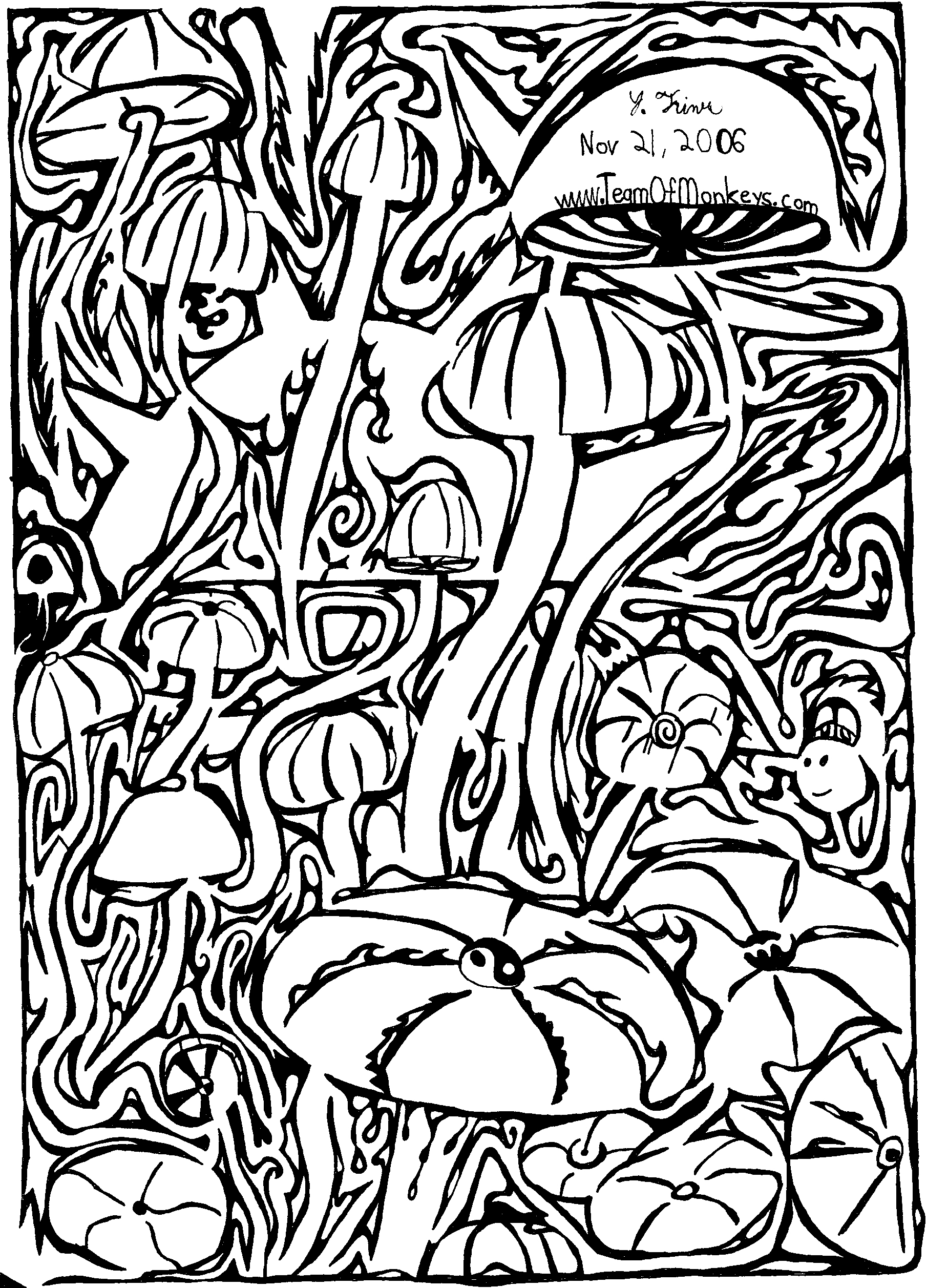
Mushroom maze
Maze A Delical
Maze of Mushrooms by Yonatan Frimer 2006
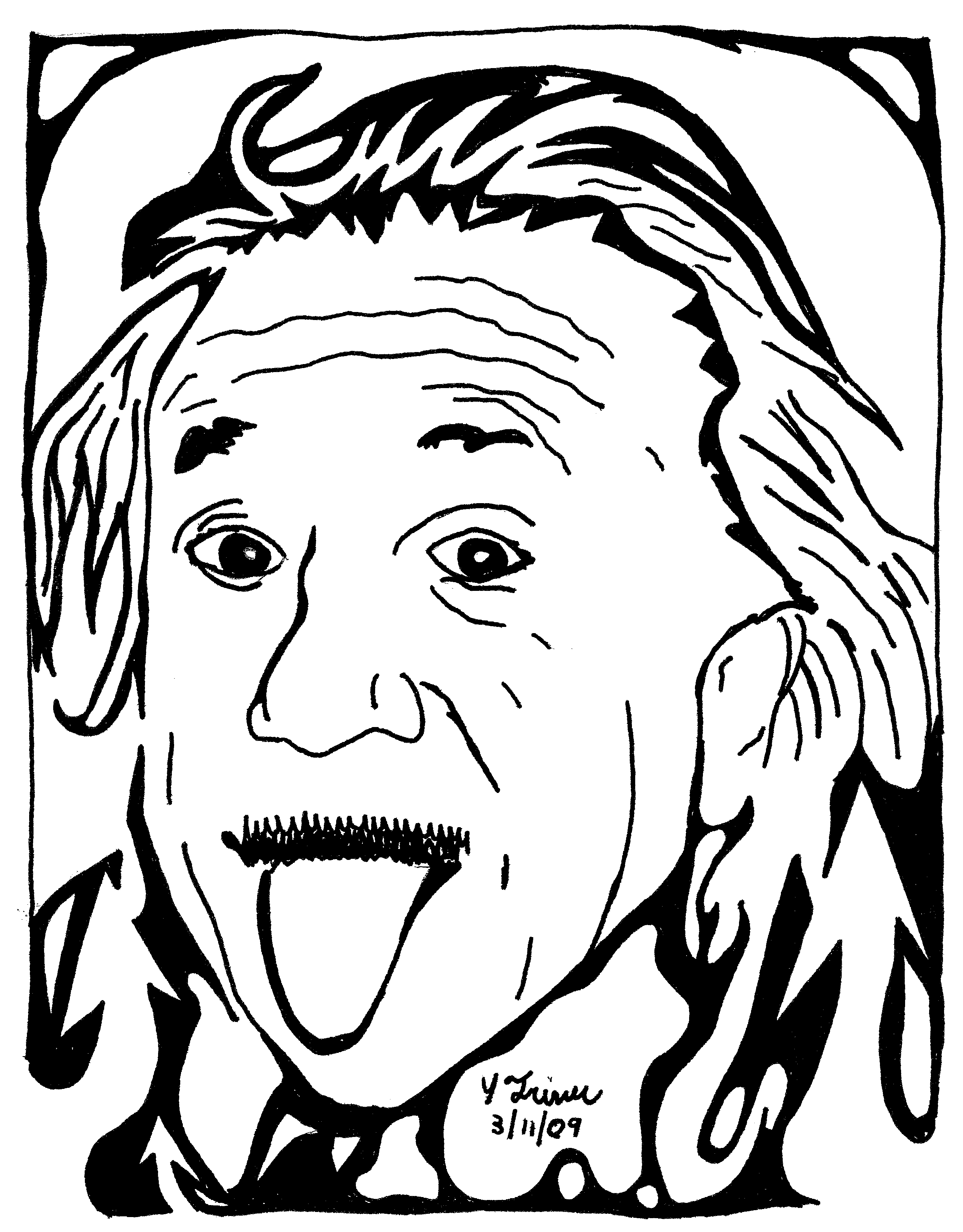
Maze Portrait of Albert Einstein.
Celebrity, artword, celebrities, portraits, famous,  Portait maze of albert einstein
"Genius Maze" - By Y. Frimer


Maze Cartoon of Erdogans comparison of Flotilla raid to September 11th.

Maze cartoon of erdogan on flotilla and armenian genocide

Maze cartoon of Turkish Prime Minister Erdogan comparing the Flotilla raid to September 11th. Someone from the crowd asks how it would "stack up against the Armenian Genocide." Created by Yonatan Frimer
Click here for a printable, hi-res version of this maze
Click here or on the image for the maze solution.

Friday, March 12, 2010

Brain replays control decision-making process

Replaying recent events in the hippocampus of the brain has more to do with active decision-making process than with creating long-term memories, according to a new study.

Conducted by researchers at Carnegie Mellon University and the University of Minnesota Medical School, the study of rats navigating a maze found that replays occurring in the hippocampus were not necessarily recent or frequent paths through the maze, as would be expected if the event was being added to memory.

On the other hand, the replays often were paths that the rats had rarely taken or, in some cases, had never taken, as if the rats were trying to build maps to help them make better navigation decisions.

Dr. Anoopum Gupta, and his colleagues said that their findings suggest replays in the hippocampus are not merely passive echoes of past events, but part of a complex, active process of decision-making.

"Our work provides clues into how animals construct a complete, fully navigable representation of their environment, even if they’ve only partially explored that environment. The cognitive maps created in this way may allow animals to plan novel routes or shortcuts. As we learn more about the neural mechanisms that enable animals to flexibly navigate through the world, we hope to apply those lessons to research in robotics that could improve autonomous navigation systems," said Gupta.

The team used electrode ‘hats’ to record brain activity of rats as they navigated a maze. In particular, they monitored certain neurons, called place cells, which fire in response to physical locations.

That enabled the researchers to identify where an event that was being replayed was located based on which place cells were firing.

During an experiment, a rat might be in one portion of the maze, while the firing of place cells in the hippocampus indicated that the rat was replaying information about a different location.

On a task with two behavioral sequences, A and B, the researchers found that the animals would replay sequence B more often though they spent most of their time running sequence A.

This meant that the rats were most likely to replay the path they had experienced less often, which indicated that replay is not just a function of helping an animal remember what it has experienced most frequently or most recently, but an important function in helping it map its whole environment.

During the replay process, the research team also was able to observe the animal making connections between paths that it had never physically traveled before.

This further suggested that replay plays a role in helping an animal learn and maintain the entire map of its environment and make connections within it.

The rats were not just reviewing recent experience to move it to long-term memory.

The study was published in the journal Neuron.

Want to test the theory, try solving some of these mazes, created by Yonatan Frimer
The maze entrances and exits are marked by arrows.


Maze of the statue of david, by Yonatan Frimer
maze of david by michaelangelomaze of Michalangelo's david statue of marble in italy
Maze Portrait Of Michalangelo's David

Check out more mazes at these links
Maze cartoon - Team Of monkeys maze
maze art - inkblot mazes


Maze portrait of Madonna, by Yonatan Frimer
Madonna Ciccone Portrait Maze

Check out more mazes at these links
Maze cartoon - Team Of monkeys maze
maze art - inkblot mazes


Maze portrait of Lilly Allen, by Yonatan Frimer
Maze of Lily Allen
Maze of Lily Allen


Check out more mazes at these links
Maze cartoon - Team Of monkeys maze
maze art - inkblot mazes


Freemason Monkeys -
Illuminati's building a wall
- Maze
freemason monkeys - illuminati apes
Click here to view the freemason monkeys maze larger

Check out more mazes at these links
Maze cartoon - Team Of monkeys maze
maze art - inkblot mazes


Monkeys For Justice - Team Of Monkeys Judicial Panel
Monkey judges, justic, courtroom, sternographers
Monkey Judges Maze:
"Trained to dispense justice in even the most difficult legal cases"
Click here to view the justice monkeys maze larger

Check out more mazes at these links
Maze cartoon - Team Of monkeys maze
maze art - inkblot mazes